Wednesday, December 14, 2011
To Many Evangelicals, More Than One-Fourth of All Americans Are in a Cult
My latest piece on Yahoo Voices. Enjoy.


Tuesday, November 8, 2011
Joe Paterno Must Go--Today
By now, anyone who’s up on the news is aware of the scandal involving recently rediscovered accusations of sexual abuse of young boys on the campus of Penn State University, allegedly committed by a then-member of the Penn State football coaching staff. It appears that, in one or more instances, this abuse was reported to head Penn State football coach Joe Paterno, who passed the allegations to his athletic director—and no farther.
 |
| Coach Joe Paterno at the 2006 Penn State Homecoming Game against U of Illinois |
Everyone agrees that Paterno fulfilled his legal responsibility by informing his athletic director (who, allegedly, did not pass this information farther on to the police). But the issue to focus on is Paterno’s moral responsibility, and here it seems that Paterno left his responsibility unfulfilled, in a catastrophic display of loyalty to the Penn State football program, over the protection of children from sexual abuse.
Paterno has alleged that the information given to him about the incident was too general to merit contacting the police. Others deny that as an issue of fact. Even if the material were general, however, as David Jones, a sports reporter for the Patriot-News put it in an article today:
Purely from an ethical standpoint, how specific did the story need to be for Paterno to simply immediately call police himself?
Had it been his grandson in the shower with [coach] Sandusky [the alleged abuser] and McQueary [the student observing the abuse] reported to him any version of inappropriate behavior, would Paterno have merely called his technical “superior” and left it at that?
Would [athletic director] Curley and Gary Schultz, Penn State’s vice president of finance and director of the university police force, still have finally gotten around to meeting with McQueary “approximately one and a half weeks later”?
In the midst of all of this, sports blogger Matt Hinton reports that Paterno is headed for a resignation—but look carefully for what Hinton says about the timing:
According to the New York Times, Penn State's board of trustees has initiated discussions about how to handle the 84-year-old standard bearer's exit "within days or weeks," amid allegations that Paterno effectively turned a blind eye to charges of sexual abuse by his longtime defensive coordinator, Jerry Sandusky. Another report, by the Associated Press, describes support for Paterno among the board as "eroding." The precise timing hasn't been determined, but the inevitable is a reality: Forty-six years after he was promoted to replace Rip Engle as Penn State's head coach, this season will be Joe Paterno's last. Saturday's game against Nebraska will be his final home game in Beaver Stadium.
But why should Paterno get a “last game” in? If Paterno’s behavior was such as to merit his resignation—and it most assuredly was—then his resignation, voluntary or forced, should be immediate. Joe Paterno should leave Penn State—today. No last game, no tribute, no nothing.
Oh, I can hear the moaning from misguided fans. “You’ve got to balance whatever Paterno may have done wrong against the rest of his career,” they’ll say; “he’s such a great man, surely you’ve got to recognize that and have some perspective and give him his last hurrah,” they’ll say.
No, I don’t. This is all just misguided rhetorical sobbing that obscured the mixed-up nature of our society’s priorities.
Folks, at the risk of stating the obvious: Football is a game. Period. Yes, it generates massive amounts of revenue, but at its core it is just as game. As a game, it cannot possibly be used to excuse Joe Paterno for not picking up the phone within five minutes of hearing even the wisp of a hint of an allegation of sexual abuse by one of his coaching staff. And the fact that Paterno did not do that should incur massive and immediate consequences.
It’s important to point out here that, if Paterno had called the police, this would likely have prevented sexual abuse. But he didn’t do that. And that kind of passivity when faced with the allegation of sexual abuse cannot, must not, be tolerated.
Anything other than insisting on Paterno’s immediate departure sends the message that football is ultimately more important than protecting children from sexual abuse. I surely don’t believe that. Do you?
If you agree that Joe Paterno should go immediately, without a victory lap, then call Penn State and express that opinion to Mr. Rodney A. Erickson, the Executive Vice President and Provost, who reports directly to the President; his office telephone number is 814-865-2505, and his fax number is 814-863-8583. (The President of Penn State, Mr. Graham Spanier, is facing calls for his own resignation in this scandal. I think you’ll have an easier time reaching Mr. Erickson.)
For good measure, you may wish to call the main Penn State telephone number (814-865-4700) and ask to speak with someone in the office of the Board of Trustees.
The message to leave with these Penn State officials: Dismiss Joe Paterno immediately, certainly before the game on Saturday. Don’t send the message that football is more important than protecting children from sexual abuse.
Putting the highest priority on the safety of innocent children is surely On The Mark.
(Readers are invited to become “followers” of this blog through the box in the upper-right hand corner. Alternatively, readers are invited to subscribe to the RSS feed for this blog.)
[The photo of Joe Paterno has been put into the public domain by its creator, and was obtained from Wikipedia.]
(Copyright 2011 Mark E. Koltko-Rivera. All Rights Reserved.)
Tuesday, August 30, 2011
Why Zombies Are So Popular
 |
| Zombie walk photo by Bob Jagendorf. |
“Zombie walks” or “crawls,” where people dress up in costume and zombie makeup to walk the streets of a community, are annual occurences in cities and towns worldwide, as chronicled on the Crawl of the Dead website. Interest in the forthcoming film version of Max Brooks’ 2006 zombie novel, World War Z, is so high, that when it emerged that there were differences between the book and the movie, the online hubbub was so great that the story reporting the controversy was subtitled “Internet Melts Down.” When the Centers for Disease Control and Prevention (CDC) wanted to publicize their ideas about being prepared for outbreaks of contagious disease and other natural disasters, they put together a webpage in May 2011 titled “Preparedness 101: Zombie Apocalypse.”
Why all this interest? What’s the attraction?
The popularity of any given film depends on the quality of the script and the acting, the direction and the production values. The popularity of any given video game depends on factors like the game play and the quality of the animation. But the popularity of a whole genre, spanning such media as film, television, and video games, reflects factors beyond any one movie, TV program, or game. Now we are in the territory of psychology.
It has long been observed that popular films reflect societal fears and nightmares, hopes and aspirations, albeit often unintentionally. The people behind the 1956 film Invasion of the Body Snatchers have sworn up and down that they were not making a movie about either Communist infiltration or McCarthyism—but that is still the way the film came off to many people. One of the seminal zombie movies, George Romero’s 1968 film Night of the Living Dead, has often been related to the trauma of racial conflict in America in the 1960s. But the racial subtext does not seem to be at work in more recent zombie movies, including Romero’s later work, the work of those he inspired, the games and films in the Resident Evil franchise, Zombieland, Left 4 Dead, or the “kinda zombie” film 28 Days Later and its sequel 28 Weeks Later.
Some people have opined that zombie movies reflect fears about the apocalyptic end of the world. That’s fine as far as it goes, but I think that zombie media reflect a far more specific fear.
I think it’s about pandemic disease.
Think about it. Romero’s original film had zombies rising from the grave due to radioactive contamination from an exploded space probe; some other films have spawned zombies from radioactive waste. But most of the non-Romero zombie media of the 1990s and 2000s, especially the wildly popular ones like the Resident Evil and 28 franchises, AMC’s much-lauded TV series The Walking Dead, and Max Brooks’ novel World War Z, have taken the tack that zombies are a result of some kind of unusual viral infection, either manmade or arising in nature.
The zombie as a metaphor for the outbreak of pandemic disease makes perfectly good sense. I find it instructive that some Canadian medical researchers published a chapter about zombie epidemiology in a serious 2009 academic book on disease modeling, a chapter titled “When Zombies Attack!: Mathematical Modelling of an Outbreak of Zombie Infection.”
Why shouldn’t our society be afraid of pandemic disease? We surely live in a world where the risk of such a disease, with potentially apocalyptic consequences, is greater than ever before. Consider these developments, just over the last half century:
• International air travel, even intercontinental travel, is much more common now. For all its many benefits, widespread international travel means that disease can spread much more quickly than in earlier generations.
• Population growth in rural China means that an ever-larger number of people live in close contact with the farm animals in which organisms such as avian flu virus incubate and mutate.
• Advances in biotechnology and genetics make it possible for well-heeled organizations to design their own microorganisms—including, potentially, pandemic disease viruses.
• The population of America has shifted radically from rural to urban areas, where disease is spread much more efficiently. The typical subway commuter into Manhattan passes more people during the morning commute than the average farmer in medieval Europe saw during her or his entire life.
• Misuse of antibiotics has lead to the rise of treatment-resistant forms of bacterial diseases like bacterial pneumonia—diseases that often come in on the tails of a viral infection such as the flu.
We know more about historical pandemics now. We know more now than ever about the 1918 Spanish Flu pandemic, which infected 500 million people, over one-quarter of the Earth’s population at the time, and which killed 3% to 6% of everyone on the planet—back in a day when almost no one travelled across oceans other than one-way immigrants and military personnel. This pandemic, fueled by the H1N1 virus, was followed by another H1N1 pandemic in 2009; although it was not a big event in the United States, this pandemic infected between 11% and 21% of the population of the world.
And now, just to make things a little bit better, the United Nations World Health Organization just issued an alert this past week about the rise of a new mutation of the H1N1 virus, a mutation which has killed 331 of the 565 people it has infected in recent months.
So society has good reason to be concerned about the possible reoccurence of a pandemic disease that could sweep the planet. That concern, in a context where the average person seems powerless, is reflected in the popularity of the zombie in so many types of media.
So what do we do? All the zombie crawls in the world won’t prepare people for a real pandemic. As in other aspects of life, when we meet real challenges with purely symbolic actions like jokes or even neurotic symptoms, we may get some emotional payoff, but the real challenge still remains.
As it happens, there is a lot that the individual can do. The aforementioned Zombie Apocalypse page on the CDC website actually has quite a lot of useful information about disaster preparedness, as well as a link to the CDC’s Emergency Preparedness and Response webpage. A lot of information about general emergency preparedness is available on the Emergency Preparedness and Response webpage of Provident Living, produced by The Church of Jesus Christ of Latter-day Saints.
Emergency preparedness is something that every family and individual needs to work on a little bit every week or so. Over time—with a little planning here, and a little purchasing there—anyone can become much more capable of dealing with legitimate emergencies of any sort.
The zombie meme reflects a widespread societal fear of pandemic disease. Far from being powerless, individuals and families can do a lot to be prepared for such emergencies.
Proactively dealing with what we secretly fear is truly On The Mark.
(Readers are invited to become “followers” of this blog through the box in the upper-right hand corner. Alternatively, readers are invited to subscribe to the RSS feed for this blog.)
[The photo of a participant in a zombie walk in Asbury Park, NJ was taken by Bob Jagendorf on 3 October 2009. It was obtained from Wikipedia, and appears here under the terms of the Creative Commons Attribution 2.0 Generic license.]
(Copyright 2011 Mark E. Koltko-Rivera. All Rights Reserved.)
Thursday, August 25, 2011
Prepare for Hurricane Irene in NYC
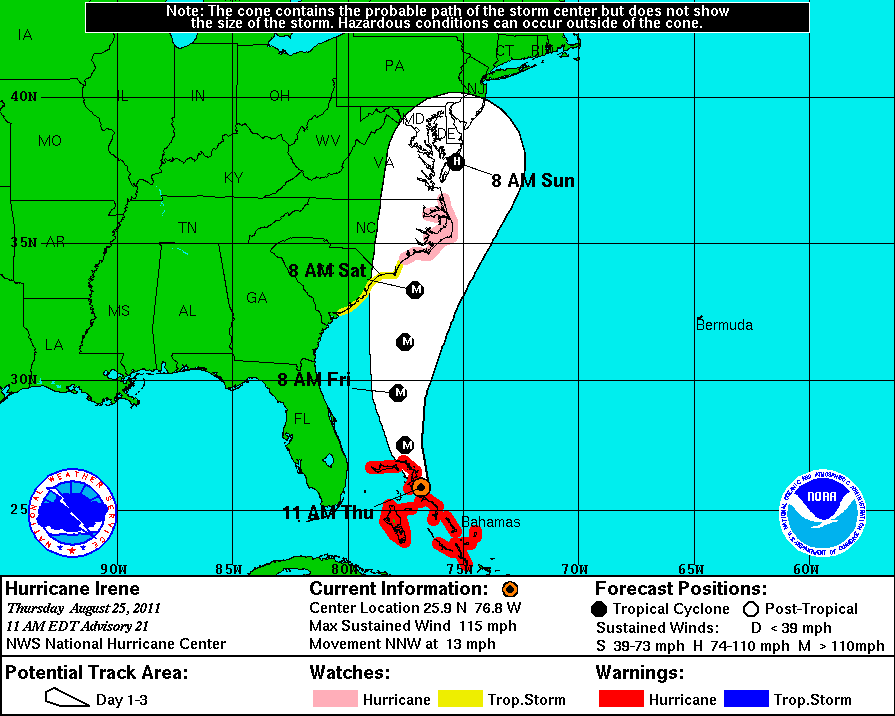 |
| The 3-day forecast as of Thursday morning |
 |
| The 5-day forecast as of Thursday morning |
A Hurricane Is NOT Just Another Big Storm
New Yorkers are used to big storms. A hurricane is not just another big storm. Yes, it will have all the hallmarks of a big storm—massive amounts of rain, hence dangerous levels of flooding—but it may also have exceedingly high winds (currently well over 100 mph in the Caribbean), and unusual electrical activity. This will make it extremely dangerous to be on the streets, to be sure, but in addition it will also possibly interrupt electrical power, either by blowing down power lines, or by simply causing electrical transformers to explode. (Even in Manhattan, electrical transformers are put just below ground under those metal grids in the sidewalks. I’ve seen them explode. It’s not pretty.)
But won’t this storm die down by the time it gets to New York City? Maybe. But no one knows, and it is entirely possible that it won’t die down that much.
So, this could be much worse than just another big storm. Even Floyd, back in 1999—massive flooding, you may recall—had been downgraded from hurricane status by the time it hit NYC. Irene may still be a hurricane when it hits.
But one can prepare for a hurricane. Below, I suggest preparations to be made today, Thursday, and tomorrow, Friday. By Saturday morning, I suspect that we will already be experiencing the “outer storm bands” of the hurricane, which will make even travel on the sidewalks difficult and maybe even perilous. You need to prepare on Thursday and Friday.
Prepare Today for the Hurricane
Preparation should address several things, roughly in this descending order of importance: shelter, food and water and other supplies, behavior during the hurricane, and the aftermath.
Shelter
If you live in an area that is prone to flooding, now would be a great time to go visit Aunt Flo in Chicago. I’m not kidding. Trains leave everyday from Penn Station; it’s not too late to get on one now, although Saturday will be too late. The flooding that accompanies a hurricane is immense, worse than just a big storm.
Even if flooding is not an issue, the extremely high winds accompanying a hurricane mean that you need to prepare your home for damage from flying debris. It would be appropriate to at least tape down your windows (for example, make a big X in masking tape on regular-sized windows) so they will be less likely to completely shatter from flying debris. In Florida, I put up plywood over my picture windows.
Food and Water and Other Supplies
Apartment dwellers need to remember that, in the event of an electrical outage, the water pumps may not function to get water to anywhere above about the fourth floor or so. Hurricanes have been known to interrupt water treatment and contaminate regular water supplies, so everyone needs to have bottled water handy, about a gallon per adult per day, just for drinking (not including cooking). I would store at least a 3-day supply of water; if there is a problem with water treatment that makes tap water undrinkable, that problem won’t just magically go away as soon as the storm passes.
New York City groceries only have about three days of food on their shelves. Anything that disrupts transportation—like a hurricane—disrupts the food distribution chain. Now is the time to sock away several days worth of food, especially including things that don’t require cooking, like bread and peanut butter. (Keep in mind that in the event of an electrical outage, electrical stoves won’t work.)
If your medical prescriptions are running out, today would be the time to renew them.
Hurricanes are not great times to be walking around a dark house with lit candles. Get flashlights and plenty of batteries in the correct sizes.
Two more words about crucial supplies: Toilet tissue.
Also, stock up on reading material and board games. If your electricity is out, you won’t be able to watch that marathon of The X-Files. ( >sniffle< )
So when do you get this stuff? Let me put it this way. New York City has the population of three full Western states, crammed into a single city. When everybody figures out “hmm—this could get bad,” do you want to be in that line? Your call.
Behavior During the Hurricane
Hurricanes always have a relative region of calm right at the center, the “eye of the hurricane.” This region passes very quickly and unexpectedly. Do not go out in the eye of the hurricane. Do not go out in the eye of the hurricane.
Prepare Now for the Aftermath
If you are in a neighborhood with overhead power lines, the hurricane may take them down. Do not approach a downed power line, even if it appears to be “dead.” Before you touch the handle of your car after the storm, first be sure that no downed power line is touching it. And, do not try to push away a downed power line yourself! Report it and eave that for the electrical workers.
Tell your clients / customers / boss you may not be to work on Monday.
Finally, however unpleasant it is to say this, whenever I’ve been in town over the last 40 years during an extended power outage, there’s been looting. Just plan to stay off the streets after the storm if there’s still power out.
One Last Super-Important Thing
Your elderly and disabled neighbors will likely need help in preparing for this hurricane. Be a New Yorker, and take the initiative to lend them a hand.
Conclusion
As we Mormons say, “If ye are prepared ye shall not fear.” This works for everyone, of any spiritual persuasion. So prepare and fear not.
More information about emergency preparedness may be found on the websites of Provident Living (a Mormon site), the Ready Campaign (a government site), and the Federal Emergency Management Agency.
Peace out, y’all. Batten down the hatches.
Being prepared for an emergency is truly On The Mark.
UPDATE
You will find a great sheet of tips, covering issues I have not addressed here, at this link, which leads to material written by Kathleen Schmid Koltko-Rivera
[The images of the 3-day and 5-day forecast of the path for Hurricane Irene were obtained from the website of the National Oceanographic and Atmospheric Administration (NOAA), a U.S. federal agency. The images are thus in the public domain.]
Copyright 2011 Mark E. Koltko-Rivera. All Rights Reserved.
Wednesday, August 24, 2011
Response to a Racist
My most recent post has a link to an op-ed piece I wrote for Yahoo! News about Rick Perry. At the time I wrote the piece, it slipped my mind that viewers are permitted to make comments on these op-ed pieces; when I remembered this today, I started looking over the comments. One of the comments did not address anything involving Rick Perry at all, but did address another surprisingly widespread attitude that is alive and well in America today. I'll let the comment speak for itself; it was posted on August 22 by someone posting under the name, "The Illuminator":
Frankly, my blood is still boiling as I type this. But I wanted to put this up on the blog, even in the heat of the moment, to bring the matter of racism in America onto my blog radar, as it were. I'm sure I'll be returning to this issue again in the future.
Note to The Illuminator: The right side won the Second World War. The racist ideology that the Axis powers built upon was a filthy abomination then, and it remains so now. The future does not belong to you.
The various crises around the world -- not the natural disasters, per se, but everything to which mankind has put its hands -- each and all have a common single cause; that cause is the degradation, diminution and destruction of racial differentiation. Miscegenation is genocide; worse, it promotes less-evolved dominant genes to the detriment of more-evolved recessive genes: except for the evils of political machinations promoting such absurd, obvious and unreasonable lies as the "manifest equality of all races" and the insanely evil and self-destructive policies and practices arising therefrom, the proper hierarchy would be preserved and leadership would have provided sufficient prosperity for each and all. What we see today is instead a matter of the animals having overtaken the farm; the pigs are now at the top, and the public has neither the mind to discern and acknowledge, let alone the stomach to correct the problem.The following is what I posted this morning as a reply to The Illuminator's comment:
I'm guessing that most of the readers of this comment might not realize exactly what "The Illuminator" is saying. He is saying that the root of all problems is that people have not kept "racial purity," but rather have mixed the races. "Miscegenation" is [a very biased term for] inter-racial marriage.Both the comment by The Illuminator and my reply are given in full. My guess is that The Illuminator is riffing on my last name, which in my case identifies me as having a varied ethnic background.
One hardly knows where to begin. First of all, from a purely scientific viewpoint, inter-racial marriage promotes a hybrid-like resistance to disease. More to the point, though, is the thoroughly racist ideology that The Illuminator is basing his comments on. Note that he gives not the slightest evidence -- not even a link to a website, weak as that type of evidence might be -- for any of his assertions blaming world crises on inter-racial marriage. No doubt what he sees as the "proper hierarchy" of the world would put him at the top of the heap. (Remember: This is exactly where the Nazis started, as an ideology.) He strongly implies that people of other races than his own are "pigs," yet he does not have the courage to actually identify himself.
Buster, I am Mark Koltko-Rivera. I have in my veins the blood of medieval Polish Catholic knights and probably more than a few Russian Jewish rabbis, the Spanish conquistadores, Marranos and Moors, the Taino natives and their Aztec-Mayan warrior ancestors, as well as the Visigoths, Ostrogoths, and Vandals who swept over so much of Europe [and ended up in Spain]. With so many strengths from so many sides of the human race, I and others like me may be set back here and there, but never defeated. Who are you to call my people "pigs"?
Frankly, my blood is still boiling as I type this. But I wanted to put this up on the blog, even in the heat of the moment, to bring the matter of racism in America onto my blog radar, as it were. I'm sure I'll be returning to this issue again in the future.
Note to The Illuminator: The right side won the Second World War. The racist ideology that the Axis powers built upon was a filthy abomination then, and it remains so now. The future does not belong to you.
Tuesday, August 23, 2011
Rick Perry's Flip-Flop Stance on the Constitution

Tuesday, July 26, 2011
Could a Norway-Style Massacre Over Religion Happen in the U.S.? You Bet.

Subscribe to:
Posts (Atom)


