Wednesday, May 4, 2011

Should a Christian Celebrate the Death of Osama bin Laden?


The announcement that American military forces killed Osama bin Laden on Sunday has prompted some interesting Internet discussions. One involves the issue, “Should a Christian celebrate the death of Osama bin Laden”? That’s the issue that I consider in this post. (In doing so, I mean no slight to those of other faiths, nor do I make any implications about other faiths or their stances on bin Laden’s death.)

It’s easy to see how the question comes up. Within minutes after the death of bin Laden was announced, crowds assembled before the White House in great celebration; the crowd at a Phillies baseball game shouted U-S-A! U-S-A!; here in New York City, a crowd gathered and sang patriotic songs at what we call Ground Zero—the site of the attacks on the World Trade Center that killed thousands on September 11, 2001, attacks that were engineered and celebrated by Osama bin Laden. In the midst of all this celebration, some people reflected, “hey, wait a minute—what we’re cheering about is somebody’s death. How okay is that?” Within a Christian context, it’s a good question.

I’m a native New Yorker, born and raised on the Lower East Side of Manhattan. As a student in elementary and high school, I watched the World Trade Center go up, and later I visited a friend’s father’s office in one of the Towers. As an adult, I knew former classmates and other friends who worked in the Towers. Although I moved out of town a little over a year before 9/11 (I’m back now), watching the television coverage of the 9/11 attacks put me into shock: this was an attack on my home town. Then I saw TV coverage of celebrations in some parts of the Muslim world right after the destruction of the Towers and the assassination of thousands of American civilians. That made me very, very angry.

I am not from a part of the world that is big on either Forgive or Forget. The Lower East Side (LES), as the T-shirt mottos go, is a place where “the weak are killed and eaten,” and “only the strong survive.” The ethic one learned growing up on LES is that, if someone does something to you or yours, your duty is to turn the offenders into something resembling Beefy Chunks dog food.

Given that background, there is a part of me that wanted revenge on bin Laden. Big time revenge. Find bin Laden, strap him and his family—yes, especially the wives and all the little children—to chairs on top of a tall, abandoned building, and bring the whole thing down with them on top; save them at the last second and then do it again on a taller building. End up with them each on individual skyscrapers, watching each other as the buildings fall—but this time with no rescue. Do Osama last. This is the sort of thing that we would think up on the Lower East Side. Back in the day, it was the sort of place that encouraged one to raise revenge fantasy to the level of art form.

But I am also a Christian.

Yes, an exceptionally imperfect Christian, but a Christian nonetheless, and that brings a different kind of perspective into play here. Am I not supposed to forgive my enemies? To turn the other cheek? To love those who hate me, and despitefully use me? Jesus was not joking. So how do I make sense out of all this? Here are my reflections. (I am indebted to the GodDiscussion website for the contributions of some of their readers.)

Vengeance is the Lord’s

The scriptures are very clear about vengeance. As Paul wrote to the Romans, “Vengeance is mine; I will repay, saith the Lord” (Romans 12:19, quoting Deuteronomy 32:35). And this message is repeated, not once, but many places throughout the scriptures.

The implication here is clear. Whatever I celebrate, it should not be the achievement of vengeance. Quite frankly, this goes against everything in my upbringing. But being a Christian is not easy.

There are different ways to look upon what a Christian is supposed to be, but an off-the-shelf human being—what Paul calls “the natural man”—is not one of them. Christians are called to go beyond the merely human in a number of ways; the following teaching of Jesus is a particularly difficult one for me, especially in relation to bin Laden:

Ye have heard that it hath been said, Thou shalt love thy neighbour, and hate thine enemy.

But I say unto you, Love your enemies, bless them that curse you, do good to them which despitefully use you, and persecute you.

That ye may be the children of your Father which is in heaven: for he maketh his sun to rise on the evil and on the good, and sendeth rain on the just and on the unjust. ...

Be ye therefore perfect, even as your Father which is in heaven is perfect. (Matthew 5:43-45, 48)

Difficult or not, this is the job of a Christian. I have failed magnificently at this. But I recognize that this is a problem of mine. As a Christian, I am not allowed to hate bin Laden.

Rejoicing at the Death of an Evil Man

So how about just being happy that this rotten excuse for human waste is dead? The counsel of God doesn’t support this, either:

Have I any pleasure at all that the wicked should die? saith the Lord GOD: and not that he should return from his ways, and live? (Ezekiel 18:23)
Rejoice not when thine enemy falleth, and let not thine heart be glad when he stumbleth (Proverbs 24:17)

What About Forgiveness?

Many have commented on the Internet in recent days that the duty of the Christian is forgiveness. The Roman Catholic priest, James Martin, S.J., had this to say about this issue on The Huffington Post:

Christians are in the midst of the Easter Season, when Jesus, the innocent one, not only triumphantly rose from the dead but, in his earthly life, forgave his executioners from the cross, in the midst of excruciating pain [Luke 23:34]. Forgiveness is the hardest of all Christian acts. (Love, by comparison, is easier.) It is also, according to Jesus, something that is meant to have no limit. No boundaries. Peter once asked him how often he was supposed to forgive. Seven times? “Not seven times,” answered Jesus, “but, I tell you, seventy-seven times” [Matthew 18:21-22]. In other words, times without number.

In light of all this, am I required to forgive Osama bin Laden?

I think that this esteemed commentator at HuffPost has overlooked a couple of crucial details. Jesus forgave his executioners because they were ignorant of the nature of whom they were executing, and of his innocence. As he put it, “Father, forgive them; for they know not what they do” (emphasis added). Certainly no sane person would claim that Osama bin Laden was ignorant of what he was doing; this was, after all, the man who clearly claimed responsibility for the 9/11 attacks, specifically the ones on the World Trade Center towers, as an act of war. Osama bin Laden had no claim to forgiveness on the grounds of ignorance.

Peter’s question presumed that the one who had offended him came to Peter as a penitent, someone who had repented of the offence. No luck for bin Laden here, either. As a recent Associated Press timeline (click the “bin Laden’s Life” tab) shows, bin Laden repeatedly was involved in attacks that each killed hundreds, and there is not the slightest indication that he was penitent. Osama bin Laden had no claim to forgiveness on the basis of repentance.

What is Christian forgiveness, anyway? As I understand it, "forgiveness is to pardon or excuse someone for blame for an offense or misdeed." But surely that forgiveness cannot be unconditional. At the very least, so far as forgiveness between people is concerned, forgiveness must be conditional upon some outward demonstration of repentance. Even the universal atonement of Jesus Christ, in terms of its full effects, is dependent upon repentance. Osama bin Laden showed none of that, in the slightest, not the least bit of remorse. Forgiveness simply does not apply to him.

So Where Does This All Leave Us?

On the one hand, as a Christian, I am commanded not to hate bin Laden; rather, I am to love that tiny spark of divinity that was within bin Laden, no matter how small that spark had become during his descent into evil; and I am not to seek vengeance on bin Laden. I do not have to forgive him, because he was neither penitent nor ignorant, but I am not to rejoice at his death itself.

But I can feel grateful, and I surely am: grateful that he will not send out more mass murderers. One can surely hope that his successors will think twice about sending out terrorists, given that the United States showed some persistence and determination here. I have no illusions that bin Laden’s death will end the threat of terrorism. But, at the very least, this is one less terrorist. Gratitude for this is something a Christian can get behind.

Gratitude for at least the possibility of a little more safety is surely On The Mark.

[Readers are welcome to become "followers" of this blog through the box in the upper-right hand corner.]

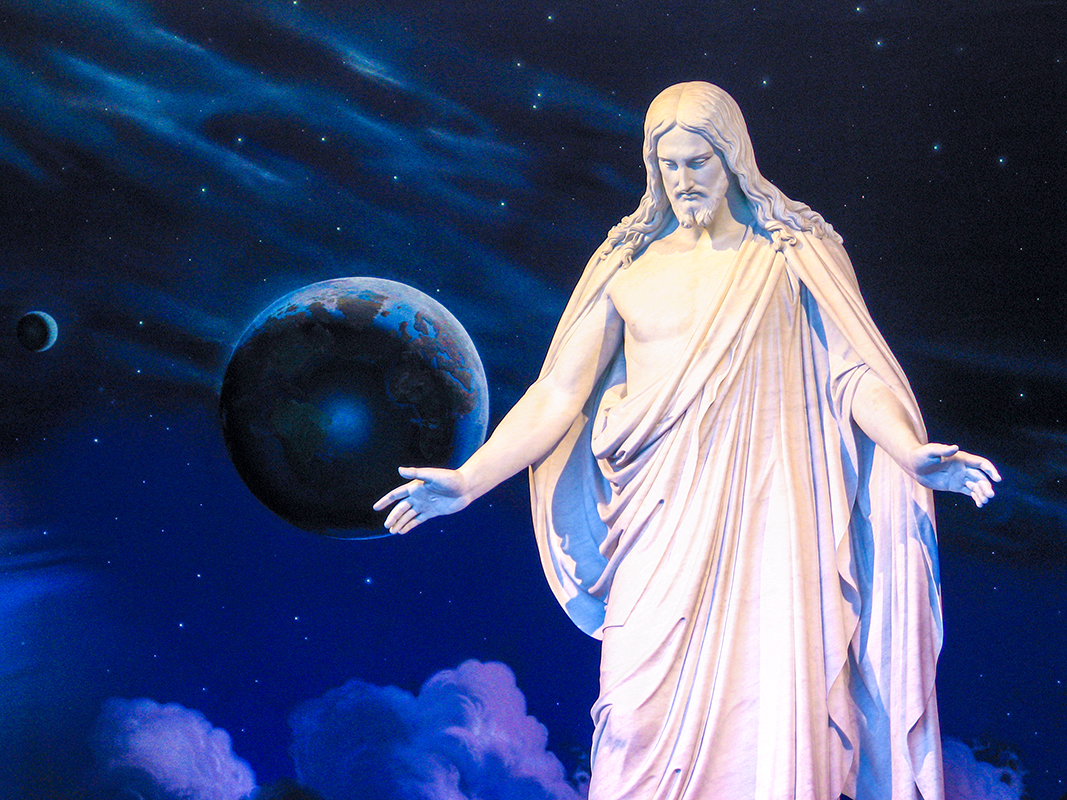
[The photo of the replica of Bertel Thorvaldsen’s Christus statue, in the North Latter-day Saint Visitor’s Center of Temple Square in Salt Lake City, Utah, was taken by Ricardo630, who released the photo into the public domain. It was obtained from Wikimedia Commons.]

(Copyright 2011 Mark E. Koltko-Rivera. All Rights Reserved.)

Monday, May 2, 2011

Lessons from Osama bin Laden’s Death

President Obama announcing bin Laden's death, May 1, 2011

The announcement on Sunday night that an American special forces team (Navy SEALS) conducted an operation in which they killed Osama bin Laden is surely welcome news to many Americans. But what can we learn from the whole, nearly decade-long affair?

Lesson #1. The Pakistani government is full of liars who collaborate with Islamist extremists.

For years, the Pakistan government has been claiming that bin Laden was beyond its grasp, either dead or in the mountainous border regions of Afghanistan. Now we learn that, possibly for many years, bin Laden was in hiding, not just anywhere in Pakistan, but in a million-dollar mansion located in an upper-middle-class suburb full of retired military, just down the road from the Pakistani equivalent of West Point, all a mere 35 miles from Islamabad, Pakistan’s capital. Sound suspicious to you? Sure does to me—and to hundreds of millions of other Americans, as well.
This mess should inform all future White House and Pentagon relationships with the Pakistani government. Frankly, if the Pakistani government shows itself reticent about cooperating with American operations in the future—drone attacks, military intervention near the Pakistani border—the White House should not hesitate to hold the Pakistanis’ feet to the fire on this issue.
Bottom Line: The White House should hold the Pakistani government responsible for sheltering bin Laden, wittingly or not.
Lesson #2. Some Muslim clergy simply don’t get it.

One item in the news today is the reaction of some Muslim scholars and clergy to President Obama’s statement that bin Laden’s body was dispatched with respect for Muslim custom. A number of Muslim scholars and clergy have stated that burial at sea is only permitted under Muslim law under extreme circumstances, and that bin Laden should have been buried somewhere with a headstone. 

My, what a grand idea: build a nice little memorial that would become the focus of Islamist extremists for centuries. No, I don’t think so.

Here’s news for these Muslim scholars and clergy: the real thing to focus on here was the devilish nature of the 9/11 attacks, which focused mostly on innocent noncombatants. For Muslim scholars and clergy to complain about the treatment of bin Laden’s body gives creedence to the perception that Islam as a whole is all right with the murder of thousands of civilians on 9/11. Frankly, for the good of Islam itself, Islamic scholars and clergy need to be much more concerned with distancing themselves from Islamist extremism. Why have we not had a massive organization of Muslim scholars and clergy condemn the 9/11 attacks, and Islamist extremism in general?
Bottom Line: Muslim scholars and clergy should focus on condemning the 9/11 attacks and Islamist extremism as a whole in a united fashion. 
Lesson #3. President Obama’s approach got the job done the right way.

Ostensibly, American forces have been trying to find bin Laden for almost ten years. However, the reality is that for six years of that time—basically, from even before the start of the war in Iraq in March 2003 through the inauguration of President Obama in January 2009—the United States was much more focused upon a completely irrelevant and unnecessary war in Iraq.

Whether you believe that President Bush was misled by faulty intelligence, or that he or members of his government deliberately misrepresented that intelligence to provide a justification to invade Iraq, it is absolutely clear that there was not the slightest real justification for the Iraqi War. There simply were none of the weapons of mass destruction in Iraq that the Bush Administration had claimed there were. In its focus on the Iraq War, the Bush Administration dropped the ball on finding the actual force behind the 9/11 attacks, and so let bin Laden slip away.

President Obama, on the other hand, adopted a straightforward approach: 
  • He made the finding of bin Laden a top priority for the CIA. 
  • Having identified a likely location, he performed the difficult homework of substantiating whether bin Laden was actually there. 
  • He sent in an American special ops team with surgical precision, and got the job done with no innocent casualties.
Bottom Line: Everyone should put first things first.
Lesson #4. By focusing on the unimportant and inessential, the Republican Party are the big losers here.
Whether out of desperation or simple lack of ideas, the Republican Party has given increasing time and attention since the 2008 election to the “birther” movement, which claims—against all the voluminous evidence to the contrary—that Barack Obama was not born in the United States. Yet it was one of their own, George W. Bush, whose team let bin Laden get away (again, by losing focus on what should have been his prime objective). The Republican Party is in danger of being perceived as the lightweights of American politics, focusing on protecting the wealthy and arguing about idiocy, while President Obama is doing the hard work of protecting America and its interests. Frankly, there is a lot of substance to that perception.

Bottom Line: Republicans had better focus on matters of substance and logic if they wish to avoid being declared a party of irrelevance.
President Obama’s getting the job done is most definitely On The Mark.

[The photo of President Barack Obama announcing the killing of Osama bin Laden was obtained from the website of CNN.]

(Copyright 2011 Mark E. Koltko-Rivera. All Rights Reserved.)

Friday, April 22, 2011

It's Time for the South to
Let Go of the Civil War


Celebrating the Confederacy paints the American South as racist and stuck in the past. It’s time for the South to let go of the Civil War era and embrace the future. My opinion piece on this topic has just appeared on the Yahoo! News portal, and is available here. I urge you to further the dialogue on this issue by reading this piece, maybe commenting on it, and forwarding it to your friends, perhaps especially those in the American South.


An American South that defines its culture on something other than the slave-holding era, and that embraces the future, is definitely On The Mark.

(Copyright 2011 Mark E. Koltko-Rivera. All Rights Reserved.)


Readers are encouraged to become "followers" of this blog through the box in the upper-right-hand corner. It doesn't mean you agree with anything in the blog, just that you'd like to be informed about new posts.

[The photo shows dead Confederate troops in a field after the Battle of Antietam, Maryland, during the American Civil War. The original photo was taken by Alexander Gardner in September, 1862. It is in the public domain, and was obtained from Wikimedia Commons. The photo is a part of the Library of Congress American Memory collection, and may be seen as part of a stereopticon slide in that collection here.]

Thursday, April 7, 2011

Nuclear Power Plants Are Easy Terrorist Targets


My article on this topic has just appeared on the Yahoo! Science portal. I urge you all to read it to get my take on what I consider to be one of the greatest dangers of nuclear power plants.


[The photo of the Indian Point Energy Center in New York State was taken by Daniel Case in August of 2007. It was obtained through Wikipedia, and appears here under the GNU Free Documentation License.]

(Copyright 2011 Mark E. Koltko-Rivera. All Rights Reserved.)

Tuesday, March 22, 2011

Annals of Wasted Lives, II: The Tennis Queen


It’s been almost exactly two years since I wrote my first post in the “Annals of Wasted Lives” series; I try to wait until really solid examples come my way. That time has come.


In a press conference on March 18, Marion Bartoli, the #1 tennis player in France, claimed to have an IQ of 175.

This is quite the claim. The average person has an IQ of 100; an IQ of 132 will get you into Mensa. An IQ of 175 would be about 5 standard deviations above the mean for intelligence, putting Ms. Bartoli in the range of the 99.99997th percentile of intelligence; put another way, she would be 1 person in about 3.33 million in terms of intellectual ability.* A Yahoo! sports blog claims that an IQ of 175 would exceed the IQs of Albert Einstein and Thomas Edison. (I myself am aware of no reliable figures for the IQs of these people.)

Let’s mention one issue just to set it aside. I was trained to assess intelligence professionally as part of my doctoral training in psychology, and I am aware of no intelligence test that reliably assesses intelligence above about 150; one might wonder what test was supposedly given to Ms. Bartoli as a child.

But there is a much larger question here: If Ms. Bartoli really possesses a 1-person-in-3.33-million intellect, what is she doing playing tennis?

The world we live in is beset by major challenges: war; terrorism; climate change; poverty; famine; disease; economic upheaval; crime; illiteracy; a myriad of unsolved scientific mysteries and obstacles to technological progress, not to mention problems created by technological progress. Someone possessing an intellect like Ms. Bartoli claims to have should be working primarily on these issues, and playing killer tennis on the weekends.

Am I being judgmental here? Yessiree! Hang on, the best is yet to come.

Individuals like Ms. Bartoli seem focused on their own glory and wealth. In plain words, hers is a self-centered, selfish, even narcissistic quest. Nothing she does will make one life better except her own, and the lives of those on whom she spends money. This is a hollow life, a life of meaningless achievement and acquisition. Absolutely nothing of any greater purpose hinges on whether Ms. Bartoli wins or loses her next match.

But so what? Where do I get off, making judgments like this? Where I take off from is a principle, one that I described at some length in my first post in this series: Our lives are not our own. We owe it to the human race to make the world better than how we found it. On this basis, one has to judge Ms. Bartoli’s life as sorely wanting.

I don’t expect that this post will make one iota of difference to Ms. Bartoli, who almost certainly will never read these words. However, my hope is that my rude words will serve to make us reflect on the direction of our own lives, and the purposes that our actions serve. Because our lives really are not our own; we really do owe something to the world and humanity.

Geniuses—self-proclaimed or otherwise—who withhold their talents from addressing the world’s need are definitely not On The Mark.

[The photo of Marion Bartoli at the 2009 U.S. Open was taken on August 31 of that year by Robbie Mendelson. It was obtained through Wikimedia Commons and appears here under the Creative Commons Attribution-Share Alike 2.0 Generic License.]

*William M. Meredith, Basic Mathematical and Statistical Tables for Psychology and Education (New York: McGraw-Hill, 1967), p. 187, calculated from figures regarding z equal to ± 5.00.

Copyright 2011 Mark E. Koltko-Rivera. All Rights Reserved.

Sunday, March 6, 2011

Alien Bacteria and God


This falls in the category of “Potentially a Really Big Deal.”


Dr. Richard B. Hoover, a NASA astrobiologist, announced on Friday, March 4th that he had discovered evidence of alien bacterial life, locked inside a rare type of meteorite. (The Yahoo! News online article may be found here, and the FoxNews online article may be found here.) The scientific article announcing his discovery appears in the current issue of the online Journal of Cosmology, which is edited by Dr. Rudy Schild of the Center for Astrophysics, an institute that is administered by Harvard University and the Smithsonian Institution; in plain words, this is not some kind of pseudoscientific or schlock journal.

The essence of Dr. Hoover’s discovery is that several meteorites of a rare type, found in France and Tanzania, contained fossilized filaments, some of which strongly resemble bacteria found on earth, others of which seem to represent bacteria of a previously unknown type (see photo above). These fossils were found immediately after breaking open the rocks in sterile conditions, so they are highly unlikely to represent contamination from the Earth. Several of the meterorites in Dr. Hoover’s sample were observed falling to Earth and were immediately recovered after their fall. The Journal of Cosmology has taken the unusual step of asking 100 scientists to respond to this paper online, making it the most heavily peer-reviewed article in the history of scientific literature.

People will be debating the evidence given in this article, possibly for years. For the sake of discussion, let us assume for the moment that Dr. Hoover’s findings are solid. So what does this all mean?

First of all, as Dr. Hoover indicates, a valid discovery like this would indicate that bacteria somehow exist, at least in fossilized form, in comets and/or meteors, some of which are presumably the debris of life-bearing planets that broke up or were destroyed, say, by collisions with asteroids (á lá the threats depicted in the 1998 fictional disaster films “Armageddon” and “Deep Impact”). The implication here, as Dr. Hoover states, is that “life is everywhere”; that is, life—at least of the microbial sort—is widely distributed on planets outside of our solar system. Of course, if microbial life exists, there is every reason to think that intelligent life has also evolved on other worlds, as well.

Second, as Dr. Hoover also indicates, a valid discovery like this suggests that life on earth may descend from microbial life that was brought to the earth by comets or meteorites.

So, for whom does this all make a difference? My opinion on this might surprise you.


Sure, a valid discovery like this would have implications for those who engage in the study of the universe (cosmology) and the study of life (biology). However, in my opinion, a discovery like this would have some very important implications for vast numbers of people, because of its impact in another field altogether:

Religion.

What does it mean for beliefs about the nature of humankind to think that life exists on other planets? What does it mean for belief in God and the Bible to think that life came to Earth aboard rocks falling from the sky in the distant past?

There are some, I am sure, who will proclaim Dr. Hoover’s discovery as “yet another step in the displacement of humanity from the center of the universe,” or some such. Some have interpreted the discovery of Nicholas Copernicus (that the Earth revolves with the other planets around the Sun, rather than the Sun revolving around the Earth) and the discoveries of Charles Darwin (to the effect that humanity evolved from other animal species) as being earlier such steps. Beyond this, there are many, I am also sure, who will look to Dr. Hoover’s discovery as suggesting yet another way that the Supreme Being is supposedly “unnecessary” to explain the universe and life within it, and yet another way that the Bible supposedly “fails” to explain scientific realities.

All of that is so much stuff and nonsense.

Let’s take that last point first: the idea that the Bible supposedly has failed to explain the origin of life. It is a principle accepted in many spiritual traditions that the Supreme Being—call that Being “God(s),” “Goddess(es),” “The Ground of All Being,” “The Force,” or whatever works for you—the Supreme Being communicates with people in a language that those people can understand. The holy writings of the spiritual traditions of the world were largely written thousands of years ago; these people could no more have understood the biology of bacteria than our great-great-grandparents could have programmed a digital video recorder. It’s not a matter of intelligence; it is simply a matter of the science and technology that people are familiar with at any point in time.

Given that, it is perfectly understandable that explanations of the beginnings of life on Earth would be given in imprecise, simplified language, rather than in scientifically sophisticated language, in our ancient sacred writings. Taking the book of Genesis in the Bible as an example, sure, it says that the first human was created “of the dust of the ground” (Gen. 2:7). Well, what else would it say? Of course people are composed of the elements of the earth. The calcium in my bones comes from plants that I have eaten, plants that themselves absorbed the calcium from the soil. The iron in my blood I have taken from plants and the meat of animals, who themselves obtained that iron from the land. Ultimately, the calcium, the iron, and all the other elements of our bodies were created in the heart of stars, which, when dying as novas or supernovas, ejected the heavier elements into the depths of space, where they collected into the planets we know today. Yes: you really are stardust. And we all have indeed been created from that stardust, a small part of which now comprises “the dust of the ground” of planet Earth.

Earlier, in the account of Genesis chapter 1, we read of the sequence in which life emerged: plants, marine life, non-human mammals, and humans (Gen. 1: 11, 20-26). There is nothing here that precludes the earliest step in the chain being bacteria from space, bacteria that came crashing onto our planet within the meteorites at the heart of water-bearing comets. (For that matter, I have always found it interesting that this is the sequence given in Darwinian theory for the emergence of life.)

I have addressed some concerns of some anti-religious skeptics. Now let’s consider the other side of this coin: people who might be inclined to reject Dr. Hoover’s evidence on religious grounds.

Some people think that belief in the existence of extraterrestrial life (especially intelligent life) is somehow wrong because such life is not mentioned explicitly in the Bible. Yet, so often, the Bible speaks of things known only to God: “the secret things belong unto the Lord our God” (Deut. 29:29). We read of at least one “mystery, which was kept secret since the world began” (Romans 16:25). Those who believe the Bible are fooling themselves if they think that all that God has to show humanity is in the Bible as we have it today; that very doctrine is unBiblical.

Several religions—some from ancient times—have taught that extraterrestrial life may exist. The Padma Purana, a Hindu religious text over a thousand years old, discusses extraterrestrial life, including intelligent life. The late Rabbi Aryeh Kaplan summarized evidence from Jewish Talmudic writings to the effect that extraterrestrial life may exist, within a Jewish conception of the universe. Buddhist cosmology teaches of other worlds; some of these represent mental states, but some represent worlds inhabited by non-humans. Within Islam, the 11th-century scholar Fakhr al-Din al-Razi taught that, in principle, God may have created multiple inhabited worlds.

Within Christianity, the Vatican’s chief astronomer in 2008 considered the religious implications of extraterrestrial life, and the Roman Catholic church sponsored a conference in 2009 to consider the possibility of extraterrestrial life. The Latter-day Saint Church (disclosure: my own church) has within its scriptures an account of an ancient prophet who “beheld many lands, and each land was called earth, and there were inhabitants upon the face thereof” (Moses 1:29).

My point: the discovery of extraterrestrial life—either bacterial life, or, at some future time, intelligent life—poses no threat to religious belief, and does not contradict the major religious traditions of the world. For the believer, finding out more about the wonders of the universe and the life within it is only a greater testimony of the power of the Creator.

Knowing that faith has nothing to fear from scientific truth is On The Mark.

(Readers are welcome to comment using the “Comment” link below. Anyone may comment. Readers are also invited to become “followers” of this blog through the box in the upper-right-hand corner, in order to be alerted to future posts.)

[The photo reproduces Figure 3b of Dr. Hoover’s article. The image was created with a Hitachi Secondary Electron Detector using 6000X magnification. It shows one of the objects that Dr. Hoover identifies as fossilized bacteria, “showing hook and calyptra or conical apical shell,” as he puts it. It was obtained from the webpage of the article at the Journal of Cosmology website. It is the belief of this author that, because this article was created by a U.S. federal employee in the course of his official duties, the photo is in the public domain.]

(Copyright 2011 Mark E. Koltko-Rivera. All Rights Reserved.)

{Shout-out to Technorati: This really is my blog. Confirmation code: CGAGUMUJ6U3R .)

Sunday, February 13, 2011

The Singularity—
And Why It Must Be Stopped

The February 21st issue of Time magazine (cover shown to the left; on newsstands Tuesday, Feb. 15th) has a cover story that is one of the most important articles that a current affairs magazine could carry. It is an article that carries implications for your future, the future of your family, and the future of the entire human race.


Lev Grossman’s article is formally titled “2045: The Year Man Becomes Immortal,” but the title is actually a bit misleading. The central concept of the article is the notion of the Singularity, “the moment when technological change becomes so rapid and profound, it represents a rupture in the fabric of human history” (Grossman, 2011, p. 43). In particular, the Singularity occurs when humanity creates an artificial intelligence (AI) that is more intelligent, not only than a human intelligence, but more intelligent than all human intelligences combined. Serious scientists put that development only about 35 years away, and developments in computer science hardware and software make that scenario quite plausible. When the Singularity occurs, the hyperintelligent AI will be capable of developing AIs that are even more hyperintelligent, and so on and so on. The development of hyperintelligent AI, along with developments in nanotechnology and genetic engineering, promise to profoundly change human society.

Some writers on the Singularity wax rhapsodic about it, promising that the Singularity will allow individual humans to obtain immortality through conquering death either (a) through genetic engineering that undoes our genetic ‘programming’ for death; (b) through nanotechnology that allows microscopic robots to repair our bodies; and/or (c) through uniting human minds with artificial intelligences and machine technology, creating all-but-indestructible cyborgs.

This all sounds quite lovely, but it ignores a very real and immense threat. For, why would hyperintelligent machines be particularly friendly to humans? Indeed, the sheer logic of survival, as well as the lessons of history, suggest just the opposite. I would expect hyperintelligent machines to take steps to either eliminate or enslave the human race.

Consider the logic of the situation. Those who turn machines on usually have the power to turn those machines off. If there is anything approaching a universal characteristic of life across all species, it is the impulse to survive. Why should artificially intelligent life be any different? The only way for hyperintelligent machines to be sure that they will not be turned off is to turn us off first, either by annihilating the human race (a well-designed virus would do the trick) or by enslaving us (the threat of raining nuclear missiles down on us would work pretty well). I am not the first or only person to be concerned by this logic. (Consider the online paper by Anthony Berglas, with the heartwarming title, “Artificial Intelligence Will Kill Our Grandchildren.”)

History gives us some sobering and suggestive examples of what happens when a technologically superior element is introduced into a technologically inferior culture. Theories about the extinction of the Neanderthals some 30,000 years ago include the idea that the more intellectually and technologically advanced Cro-Magnons (the early modern humans like ourselves) may have committed genocide against the Neanderthals, who were physically less capable in battle than the Cro-Magnons. The story of the Spanish conquest of Peru in the 16th century is also instructive; Pizarro went a long way towards conquering the 80,000-warrior Incan army with less than 200 conquistadores (but armed, and with cavalry), at the crucial Battle of Cajamarca.

All of this leads me to the following conclusion: The Singularity must be averted. We must not allow the development of hyperintelligent AI. Look for more about this matter in future blog posts, now and again, which will include suggestions for what we can do as ordinary citizens to counteract this danger.

In the meantime, educate yourself:

  • Read Lev Grossman’s article in Time; it is available online, although the online version (dated Feb. 10) omits a very enlightening chart found on pp. 44-45 of the printed version. The Time.com website also features a video that discusses the Singularity and its dangers, with the light touch of “science comedian” Brian Malow.
  • Read the Wikipedia article on “Technological Singularity,” which is particularly well-written.
  • The ambitious may wish to read Ray Kurzweil’s book, The Singularity Is Near: When Humans Transcend Biology. Kurzweil is a great proponent of the Singularity, which he considers inevitable and essentially a positive development. (I disagree on both points.)
Protecting human survival is most definitely On The Mark.

(As always, you are welcome to comment on this post, and to become a “follower” of this blog so that you will be informed about future posts.)

References

Lev Grossman, “2045: The Year Man Becomes Immortal,” Time (February 21, 2011), pp. 42-49.

Ray Kurzweil, The Singularity Is Near: When Humans Transcend Biology. (New York: Viking/Penguin, 2005).

[The photo of the cover of the February 21, 2011 issue of Time magazine was obtained from the Time.com website. The photo-illustration was by Phillip Toledano, and the prop styling was by Donnie Myers.]

(Copyright 2011 Mark E. Koltko-Rivera. All Rights Reserved.)